Showing posts with label Purification. Show all posts

Sunday, 7 April 2024

Book Release: Some Secrets of the Divine Approach

 The sixth volume of the Pinnacle Papers is now available from Nawa Books


Blurb:

In Islam, there are fundamental principles, each of which stands first on the pillar of belief and secondly on conduct. This book contains a brief explanation of all these fundamentals: it clarifies their basis first from the texts of the Quran and the authentic Sunnah and then, second, succinctly explains their content.

Third, it then discusses their wisdom and benefit to society and the secret behind their legislation. Thus, it combines the knowledge of Islam as creed, thought, and conduct. Among these fundamentals are: faith in Allah and the secret behind its necessity, the way to unite the Muslims, the remembrance of Allah and its effect on man’s life, knowledge is the foundation of all conduct and creed, gentleness in following religious rulings, and separating from evil and its people.


From the introduction:

"In this volume, Imam al-Būṭī, may Allah have mercy on him, delves into a topic that many people overlook or maybe never even think about, which is that there is profound wisdom behind everything Allah does and everything He commands, the first of which is the command to believe in Him and acknowledge one’s slavehood to Him.

After that, the imam lists more than twenty other commands and their wisdoms, ranging from raising children and being good to parents to justice in transactions, from not accepting reports from dubious sources to explaining how true knowledge is the source of every word and deed, from the wisdom of dhikr to the wisdom of duʿāʾ, and so forth.

Upon finishing the book, all of this leaves the attentive reader in a far better position than when he started, for now he has a profound understanding of and insight into Allah’s commands, which are the foundation of his relationship with Allah.

His commands are His expectations of you; you demonstrate your love to Allah by meeting those expectations. When you understand that those expectations are rooted in His love and concern for you, you will find yourself enthusiastic and eager please Him.

And with Allah alone is every success."

Scroll down to find the Amazon link for your region.

Thursday, 16 November 2023

If My slaves ask you about Me, I am near.

 A translation of this fatwa from Naseem al-Sham

Question:

Respected Sheikh Muammad Shuqayr,

By Allah, I love your words. Please. Is there any fatwa that allows a person to kill himself, even if it is by way of a drug? For a long time, I have not wanted to live. I have lived my whole life reluctantly. Everywhere I turn, I face tribulations. I have only experienced a few happy days in my entire life. Everything is difficult. I have responsibilities, I have to be patient. And so on and so forth. In my childhood, I decided to be devout and committed, because I was raised that way and I knew it was the best way. I have knocked on Allah’s door and I continue to do so. I memorised Allah’s book and I spent many years doing so, trying to get out of what I was in, or to improve the state of my affairs. I performed the ʿUmrah, and then the ajj. Maybe it is accumulated sins. Maybe it is disobedience. I have not found a way out. I am always feeling remorse over my sins, and regret, and I cannot rid myself of it. Maybe an hour that I spend in the gatherings of knowledge helps me forget, but it all comes back as soon as I leave. I am not prepared to live anymore. I have become weary. There is no benefit in my life, whatever I do and whoever I am. I feel there is no point in doing anything. Please give me some guidance, and may Allah reward you. To Allah we belong and to Him we shall return.

Answer (Sheikh Rushdi Salīm al-Qalam):

Praise be to Allah and He suffice, and peace be upon His Messenger, al-Muafā.

To proceed:

It is not permissible for a person to kill himself, regardless of the reasons, because the spirit that is between your two sides belongs to Allah, the Unique, the Dominant. Allah, Mighty and Majestic is He, has created life and death as a trial and as a choice, so be patient with what Allah has tested you with. Give glad tidings to the patient, and Allah is with the patient. Know that Allah is Forgiving, Most Merciful; He accepts the repentance of His slaves. It is not from our Religion that we punish ourselves. We know that Allah accepts the repentance of His sinning slave if they repent and fulfil the conditions of repentance and turning back to Allah the Exalted. Attend more gatherings of knowledge, keep the company of the righteous, and open a new page between you and Allah; you will find that Allah is Forgiving, Most Merciful. And if you want something, do not ask anyone but Allah. “If My slaves ask you about Me, I am near. I answer the call of the caller when he calls on Me. They should therefore respond to Me and believe in Me so that hopefully they will be rightly guided.” [al-Baqarah 2:186]

[The answer is from Sheikh Rushdi Salīm al-Qalam because Sheikh Muammad Shuqayr is very busy these days.]

Wednesday, 17 May 2023

Book Release: Al-Fiqh Al-Manhaji: A Systematic Manual According to the Madhhab of Imam Ash-Shafi'i, Volume 1, Purification & Prayer

Alhamdulillah, the book is now available from Nawa Books


Blurb:

The best that man preoccupies himself with is knowledge of the lawful and the unlawful regarding rulings, and knowing the valid from the invalid regarding actions; it is the science of fiqh that has taken it upon itself to elucidate that. Many of the early scholars wrote so many books in this field that it is almost impossible to count; including exhaustive works, abridged works, commentaries, and research papers focusing on main issues as well as branch issues. The Islamic library still needs to grow, which is this book’s point of departure; it covers the main fiqh issues along with their evidences from the Noble Book and the Purified Sunnah, and the authors have also added whatever wisdoms can be gleaned from each ruling. The wording is clear and concise and the numerous headings and subheadings make it very easy for the reader to navigate the various topics and issues.

Excerpts:

What is Zakāt al-Fiṭr?
What are the Mufaṣṣal in the Qurʾān?
Introducing Shafi'i Fiqh

The Authors:

The authors are Imam Mustafa al-Khin, may Allah have mercy on him, Imam Ali ash-Sharbaji, may Allah preserve him, and Imam Mustafa al-Bugha, may Allah preserve him. Here are a few clips from Imam Mustafa al-Bugha's lessons:


And with Allah alone is every success!

Nawa Books ships worldwide and the book is also available from Amazon.

Friday, 18 February 2022

Book Release: Inward Sin

Alhamdulilah, the book is now available


The book is available from Nawa Books and they ship worldwide. Insha'Allah, bookstores in Europe, North America and elsewhere will be stocking it soon.


And with Allah alone is every success!


Wednesday, 3 November 2021

Blessed Deaths

 A podcast with Safina Society


The podcast is also available on Soundcloud.

The Opening of the Hearts is available from Lulu. Through November 5th, there is a 20% discount. Please use the code EARLYBIRD20.

Monday, 23 August 2021

Book Release: Man and Allah's Justice on Earth

 Alhamdulilah, the book is now available


From today, the book is available from Nawa Books and they ship worldwide. Insha'Allah, bookstores in Europe, North America and elsewhere will be stocking it soon. 

 Please click here to read an excerpt. 

And with Allah alone is every success!

Thursday, 1 April 2021

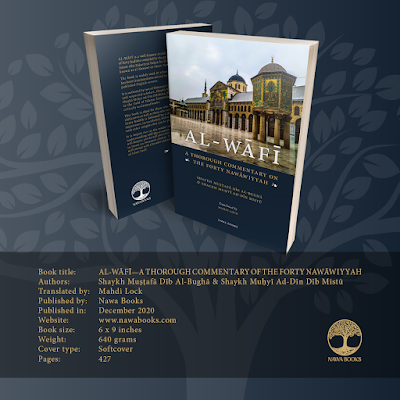
Book Release: AL-WĀFĪ - A THOROUGH COMMENTARY ON THE FORTY NAWĀWIYYAH

 Alhamdulillah, this book is now available:


If you are in the UK, the book is available from Madani Bookstore.

If you are in the US, the book is available from Furqaan Bookstore.

Insha'Allah, other locations will be added soon, including South Africa and Malaysia.


And with Allah alone is every success!

Friday, 31 July 2020

Introduction to the book The Approach to Human Civilization In The Qur'an


Al-Hajj Abu Ja'far al-Hanbali joins me to talk about Imam al-Bouti, his life, his rank, and his works. Alhamdulilah, the book is now available in North America.

More details can be found here.

And with Allah alone is every success.

Saturday, 2 May 2020

The Fruits of Patience, Relief from Distress, Hardship and Ease

An excerpt from the upcoming translation of al-Wāfī fī Sharḥ al-Arbaʿīn an-Nawawiyyah by Imams Muṣṭafā al-Bughā and Muḥyī ad-Dīn Mistū, p.145-147


 1. The Fruits of Patience

You can deduce from the aforementioned that that the fruits of patience include: contentment, tranquillity, feeling happy, realising might, honour and goodness, and being deserving of Allah’s support, Mighty and Majestic is He, as well as His victory and love. On top of all of that, there is the fruit of the Hereafter, which is embodied in that permanent blessing that they obtain in full without any reckoning: “The steadfast will be paid their wages in full without any reckoning.” [Az-Zumar 39:10] They will be in a Garden as wide as the heavens and the earth, adorned with reverent angels greeting them: “Gardens of Eden which they will enter, and all of their parents, wives and children who were righteous. Angels will enter in to welcome them from every gate: ‘Peace be upon you because of your steadfastness! How wonderful is the Ultimate Abode!’” [ar-Raʿd 13:25] The Lord of Might turns to it with forgiveness, victory and pleasure: “Today I have rewarded them for being steadfast. They are the ones who are victorious.” [al-Muʾminūn 23:111] “But give good news to the steadfast, those who, when disaster strikes them, say, ‘We belong to Allah and to Him we will return.’ Those are the people who will have blessings and mercy from their Lord.” [al-Baqarah 2:155-157] One should take note of the victory Allah, Mighty and Majestic is He, grants His believing slaves, the Day when neither wealth nor children will be of any benefit, except to those who come to Allah with sound hearts.[1] For everything mentioned above, patience is the best thing a person can be given. The Messenger of Allah, may Allah bless him and grant him peace, spoke the truth when he said, {No one has been given a greater and vaster gift than patience.} This is agreed upon.

2. Relief from Distress:

Man is constantly dealing with trials and afflictions and is exposed to various kinds of tribulation. Matters become unbearable and oppressive for him, such that he reaches a point in which grief and sorrow take over his soul, and he falls into distress. All of this is a test from Allah the Glorified, and until the believer carves his path towards Paradise with merit. If he succeeds in the test, and is thus patient and anticipates reward in the manner that has been described, does not become exasperated or despair, realises that all of this is according to Allah the Exalted’s decree and predestination and is thus content with it and his soul trusts in Him, Allah the Exalted’s solicitude seizes him, he is relieved of his grief, sorrow is removed from his soul, he is freed from every oppression and he is saved from every agony. That is the clear victory and the immense triumph in this life and the Hereafter. This is when it becomes clear to the believing slave who has taqwā that light bursts forth from within darkness, that abundant rain comes from dark clouds, that the distress he was in was only for some good that was willed for him, that relief will come from within this distress, and that this was for nothing other than that the sincere slave be cut off from everything besides Allah, Mighty and Majestic is He, that he attach his heart to his Creator alone, the heart that is certain that the entire affair is in His hand. Read these meanings in Allah’s words, Mighty and Majestic is He: “Or did you suppose that you would enter Paradise without facing the same as those who came before you? Poverty and illness afflicted them and they were shaken to the point that the Messenger and those who believed with him said, ‘When is Allah’s help coming?’ Be assured that Allah’s help is very near.” [al-Baqarah 2:214]

Allah the Exalted has also said, “It is He who sends down abundant rain, after they have lost all hope, and unfolds His Mercy.” [ash-Shūrā 42:28] Maybe you can see this meaning clearly in the story of Kaʿb ibn Mālik and his two companions, may Allah be pleased with them, when they stayed back from the battle of Tabūk and the Prophet, may Allah bless him and grant him peace, commanded people to disassociate from them. Then they were afflicted with the distress that they were afflicted with, until: “the earth became narrow for them, and their own selves became constricted for them and they realised that there was no refuge from Allah except in Him”. Then there was relief and there was mercy: “He turned to them so that they might turn to Him. Allah is the Ever-Returning, the Most Merciful.” [at-Tawbah 9:118] You can see the same in the stories that the Qurʾān relates to us, stories of His prophets and saints being relieved of their distresses, and how Allah the Exalted honoured His prophet Muḥammad, may Allah bless him and grant him peace, and his Companions, may Allah be pleased with them, in these kinds of situations. This makes us trust in Allah’s mercy, Mighty and Majestic is He, and desire His magnanimity, whenever calamities intensify, adversity surrounds us and distress becomes ingrained.

3. Hardship and Ease:

You will notices that the meanings of the ḥadīth are closely tied together, some of them taking from others. Hardship causes distress, and ease is one of the doors of relief. Everyone needs patience and durability, and behind that, there is triumph and victory. All of that is from Allah the Exalted’s bounty and mercy towards His slaves, for He has established the norm that hardship be followed by ease or connected to it. He the Glorified says, “Allah will appoint after difficulty, ease.” [at-Ṭalāq 65:7] and He has said, “For truly with hardship comes ease; truly with hardship comes ease.” [ash-Sharḥ 94:5-6] This is why He the Glorified has only legislated for His slaves that which contains ease: “Allah desires ease for you; He does not desire difficulty for you.” [al-Baqarah 2:185] and He has and lifted them that which contains adversity, difficulty and hardship: “…and He has not placed any constraint upon you in the religion.” [al-Ḥajj 22:78]

Al-Bazzār has related in his Musnad from the ḥadīth of Anas, may Allah be pleased with him, that the Prophet, may Allah bless him and grant him peace, said, {If hardship were to come and enter this hole, ease would come so that it could enter and remove it.} Allah, Mighty and Majestic is He, then revealed, “For truly with hardship comes ease; truly with hardship comes ease.” His words, may Allah bless him and grant him peace, are emphasising that hardship and difficulty are never prolonged for a person, as long as he is content with what Allah the Glorified has predestined for him, he adheres to what Allah has commanded and forbidden, seeks refuge in Him alone and trusts Him to turn his hardship into ease: “Whoever puts his trust in Allah – He will be enough for him.” [at-Ṭalāq 65:3]

[Translated from p.145-147 (Damascus: Dār Ibn Kathīr, 1428/2007) ]
_________________
[1] (tn): this is a paraphrase of Sūrat ash-Shuʿarāʾ 26:88-89

Wednesday, 18 March 2020

Fatwā Regarding the Suspension of the Jumuʿah Prayer and Khuṭbah as well as Congregational Prayers and all Other Gatherings in Masjids

A translation of this fatwa

 
In the Name of Allah, the All-Merciful, the Most Merciful
Fatwā of the Scholarly Fiqh Council of the Ministry of Endowments and the Scholars’ Union of Sham

Regarding the Suspension of the Jumuʿah Prayer and Khuṭbah and Congregational Prayers in Masjids because of the Coronavirus

· In accordance with the fiqhī rulings that are contained within the objectives of the Islamic Revealed Law for the sake of preserving life, protecting against illnesses as much as possible, and maintaining the physical health of those who are legally accountable;

· In accordance with the World Health Organization declaring that the coronavirus has become a global pandemic, and that nowhere in the world is removed from this danger;

· Out of concern for the well-being of those who pray and frequent the masjids, to support precautionary measures against the spread of gastric and infectious diseases, within measures to combat the spread of the coronavirus;

· In accordance with the necessary instructions issued by both governmental and health authorities to close schools, universities, institutes and other educational facilities temporarily in order to avert harm;

· In accordance with the established fear of experts and specialists within the medical profession, and others, that this epidemic will definitely or most likely spread because of crowded places and gatherings;

· Because the jurists[1] have established that preponderant likelihood[2] holds the place of certainty in juristic rulings of the Revealed Law;

The Scholarly Fiqh Council and the Scholars’ Union of Sham declare the following:

Fatwā Regarding the Suspension of the Jumuʿah Prayer and Khuṭbah as well as Congregational Prayers and all Other Gatherings in Masjids, temporarily, until the reasons behind said suspension cease to be, based on an official statement from the Ministry of Health. This is because, in emergency circumstances such as these, the fuqahāʾ must take into consideration the calamities that have befallen people when giving their rulings, which is to consider that which will protect them from harm and save lives, and that which is in accordance with the Islamic Revealed Law. Thus, we hold that:

1. There is no objection in the Revealed Law:

· To suspending congregational prayers (which are an emphasized sunnah)[3] in masjids and sufficing with performing them at home, temporarily, until the reasons behind said suspension cease to be, based on an official statement from the Ministry of Health.

· To suspending the Jumuʿah Prayer and Khuṭbah in masjids, and thus people must pray Ẓuhr in their homes instead of Jumuʿah, temporarily, until the reasons behind said suspension cease to be, based on an official statement from the Ministry of Health.

· To suspending all classes, meetings, social gatherings and celebrations in masjids, as well as all halls that are specifically for celebrations or grieving, temporarily, until the causes behind said suspension cease to be, based on an official statement from the Ministry of Health.

- Due to the Exalted One’s statement: “Wherever you turn, there is Allah’s Face. Allah is All-Encompassing, All-Knowing.” [al-Baqarah 2:115]

- And the ḥadīth of the Prophet, may Allah bless him and grant him peace, {For me, the earth has been made both a masjid and made pure.}

2. It is obligatory in the Revealed Law:

· To utilize the means of protection against the epidemic, treatment and quarantine as obligated by the Ministry of Health.

· If one feels that they are afflicted with the epidemic, to openly declare it so that the infection is not transferred to others and so that diseases do not spread.

- Due to the ḥadīth of the Prophet, may Allah bless him and grant him peace, {The one who is ill is not brought into the presence of the one who is healthy.} (Agreed upon.)

- And due to his ḥadīth, may Allah bless him and grant him peace, {There is to be no harm and no reciprocating of harm.} (The Muwaṭṭaʾ of Imam Mālik.)

3. It is permissible in the Revealed Law:

· To suffice with merely giving the call to prayer[4] for the five daily prayers from the masjids, temporarily, until the reasons behind said suspension cease to be, based on an official statement from the Ministry of Health.

· That the muʾadhdhin say at the end of the adhān: ‘People, pray in your homes. O Allah, lift tribulation, epidemics and evil illnesses from us.’ This is legitimate in times of epidemics and gastric diseases.

- Due to the ḥadīth of ʿAbdullah ibn ʿUmar, may Allah be pleased with him, from the Prophet, may Allah bless him and grant him peace, that he would command the caller to call people to pray and then tell them to pray in their stopping places on cold nights and rainy nights, which is agreed upon. In other words, pray in your homes, and if this is the case with rain and severe cold, then in times of epidemics and contagions it is even more so.

4. Likewise, we ask you to seek refuge in Allah the Exalted, to deliver His lands and His slaves from tribulation and disease:

· Especially in the hours before dawn,[5] by seeking Allah’s forgiveness and doing a lot of glorification[6]

· By asking Allah for pardon and well-being, especially when prostrating and in places where supplications are more likely to be answered

· By sending lots of blessings upon the Beloved Prophet, may Allah bless him and grant him peace

- Due to Allah’s statement: “I said, ‘Ask forgiveness of your Lord. Then He is Endlessly Forgiving. He will send the sky down on you in abundant rain and provide you with more wealth and children, and grant you gardens and grant you waterways.’” [Nūḥ 71:10-12]

- Due to His statement, Exalted and Blessed is He: “The part of the night they spent asleep was small, and they would seek forgiveness before the dawn.” [adh-Dhāriyāt 51:17-18]

- Due to his statement, may Allah bless him and grant him peace, to Ubay ibn Kaʿb, may Allah be pleased with him, when he said to him, ‘I have made my entire supplication the sending of blessings upon you’: {Therefore, Allah will take care of whatever troubles you in your worldly life and your Hereafter, and will forgive you your sins.} (at-Tirmidhī)

- Due to the statement of Imam ash-Shāfiʿī: ‘I have not seen anything more beneficial in the face of disease than at-tasbīḥ.’ (Ḥilyat al-Awliyāʾ)


Asking Allah the Exalted to deliver us from tribulation and disease

Damascus, 19th Rajab, 1441/ 14th March, 2020


The Scholarly Fiqh Council                        The Scholars’ Union of Sham


[1] Ar. al-fuqahāʾ
[2] Ar. ghalabat aẓ-ẓann
[3] Ar. sunnah muʾakkadah
[4] Ar. al-adhān
[5] Ar. al-asḥār
[6] Ar. at-tasbīḥ, i.e. saying Subḥān Allah

Friday, 22 November 2019

Book Release: The Approach to Human Civilization in the Qurʾān

By Imam Muhammad Saeed Ramadan al-Bouti, may Allah have mercy on him

https://darfikr.com/paidbook/approach-human-civilization-quran


Alhamdulilah, the translation of Imam al-Bouti's book is now available from Jamalon and Neel wa Furat.

Blurb:

This book contains – perhaps for the first time – the study of a comprehensive Qurʾānic structure for a unique social education that can promote the establishment of a sound, stable civilizational rebirth.

It also contains – again for the first time – an inquiry into the foundations of knowledge and its point of departure in the Qurʾān, which most people have neglected until today. This book, with all of the above that it contains, is placed in front of those who say, ‘We have looked and we have not found a comprehensive educational theory in the Quran.’


A summary can be found here and an excerpt is available here.

As for regional bookshops and distributors, Nawa Books in Singapore has the book.

UPDATE: Madani Propagation in the UK is now stocking the book.
UPDATE: Wondrous Islam in Canada is now stocking the book.
 
If you would like to stock or distribute the book in your region, please send me a message via the contact form on the right-hand side of this blog. If Dar al-Fikr do not have a distributor in your region, I can speak to them on your behalf, and with Allah alone is every success.

Related Posts:
Civilisation: A Preliminary Discussion
ʿUmar ibn al-Khaṭṭāb's advice to Saʿd ibn Abī Waqqāṣ 


Insha'Allah, a virtual book launch will be available soon. A promo video is available here.

Saturday, 12 October 2019

ʿUthmān ibn Ertuğrul's Advice to His Son

From the forthcoming translation of the book Man and Allah's Justice on Earth, by Imam Muhammad Saeed Ramadan al-Bouti, may Allah have mercy on him:


The Sword of ʿUthmān ibn Ertuğrul

The founder of the Ottoman Empire, the warrior ʿUthmān ibn Ertuğrul, had an immense amount of experience in this reality. He saw with his own eyes how this divine standard practice controls the flow of history and the conflicts between nations, so much so that when his death was approaching, he turned to his son and squeezed out this reality for him from his experiences, giving him some rare, exquisite advice, part of which was:

‘Take this lesson from me. When I came to this land, I was as weak as an ant, and then Allah granted me these majestic blessings. Adhere to my way and follow my example. Strive to strengthen this Muḥammadan religion and to respect its people. That is the obligation of kings on earth.’[1]


[1] Allow me to substantiate the text of this advice as it is quoted in the book Abū al-Fatḥ as-Sulṭānī Muḥammad ath-Thānī by ʿAlī Himmat, which has been translated into Arabic by Muḥammad Iḥsān ʿAbdul ʿAzīz. It will draw your attention to many lessons, explain to you many of the meanings behind events and increase your faith in the justice of the Most High, the Supreme, who says in His Masterful Book, “Allah never changes a people’s state until they change what is in themselves.” [ar-Raʿd 13:11] The full text is as follows:

‘Give precedence to the Religion over everything else, and do not slacken in persevering therein. Do not employ people who do not care about the Religion, do not avoid major sins and are immersed in iniquity. Avoid harmful innovations and distance yourself from those who provoke you towards it and towards oppression. Expand our territory by way of armed combat (jihād), guard the money of the Muslim treasury against waste and strive to increase the wealth of the empire.

Have compassion for the men of the empire, who have devoted their lives to serving it with honesty and sincerity. Grant your protection to their children and progeny. Safeguard for the destitute their strength, do not stretch your hand towards the wealth of any of your subjects and offer your compassion and generosity especially to those who deserve it. Strive to use the troops of the army well and to grant them sufficient rest.

The scholars and men of letters are the force that is dissipated throughout the body of the empire, so be kind to them and encourage them. If you hear that one of them is in another country, summon him and ennoble him with wealth and generosity so that he comes to reside in your country.

Beware, beware of being deceived by wealth and soldiers! Do not banish the people of the Revealed Law from your door, and do not incline towards any action that contravenes the rulings of the Revealed Law. The Religion is our objective and guidance is our way. Take this lesson from me. When I came to this land I was as weak as an ant, and then Allah granted me these majestic blessings. Adhere to my way and follow my example. Strive to strengthen this Muḥammadan religion and to respect its people along with the rest of your obedient subjects. Do not spend more than is necessary from the finances of the empire, do not withhold your sincere advice from your successors and relieve your subjects from oppression.

When I die, bury me under the silver dome in Bursa. If anyone entrusts you with something that Allah has not commanded, do not accept it, and if you do not know something concerning knowledge of the religion, ask someone who does.’


[Translated from Al-Insān wa ʿAdālatu Llāhi fil-Arḍ (Damascus: Dār al-Fikr, (forthcoming), p.60-62]

Related:
ʿUmar ibn al-Khaṭṭāb's advice to Saʿd ibn Abī Waqqāṣ

Wednesday, 18 September 2019

ʿUmar ibn al-Khaṭṭāb's advice to Saʿd ibn Abī Waqqāṣ

From the book The Approach to Human Civilization in the Qur'an by Imam Muhammad Saeed Ramadan al-Bouti, may Allah have mercy on him, the full translation of which will be released soon, if Allah so wills


Look at his statement, may Allah bless him and grant him peace, {The nations will gather against you just as people gather together to eat from one dish.} They said, ‘Will we be few in number at that time, O Messenger of Allah?’ He replied, {No. You will be many, but you will be foam like foam on a river. Allah will remove the fear of you from the hearts of your enemies and throw wahn[1] into your hearts.} They said, ‘What is wahn, O Messenger of Allah?’ He replied, {Love for this worldly life and hatred of death.}[2]

Come and look at the advice that the Commander of the Believers, ʿUmar ibn al-Khaṭṭāb, gave to Saʿd ibn Abī Waqqāṣ when he was setting off for the Battle of Qādisiyyah. He warned him and those with him against falling into the consequences of this weighty divine standard practice. He called upon him to keep his army away from the deviations and slips that would make them liable to fall into the grip of oppressors. Part of what he said was:

‘O Saʿd, the son of Umm Saʿd, do not let yourself be deceived because they call you the paternal uncle of the Messenger of Allah, for indeed Allah does not replace evil with evil but rather He replaces evil with good. There is no connection between Allah and any individual except through obedience to Him. I command you and those with you to be warier of yourselves than of your enemy, for the sins of the army are a greater threat to them than their actual enemy. The Muslims are only given victory because of their enemy’s disobedience of Allah. If that were not the case, we would have no power against them, because our numbers are not like their numbers and our equipment is not like their equipment. If we are equal in disobedience, then they have power that is superior to ours. If we are not victorious over them because of our merit, we will never get the better of them because of our power. Do not say that our enemy is worse than us, and thus they will never be granted authority over us, for it is often the case that a people are put under the authority of someone worse than them. For example, when the Children of Israel committed disobedience, Allah put them under the authority of the disbelieving Magians, who entered the innermost part of their homes and it was a promise that was fulfilled.’

The purpose behind surveying these texts is so that you can clearly see the difference between being given honour and distinction and being given authority, and so that you understand that the West having the upper hand with its civilization, its power and its vigour over the Islamic Ummah is similar to the upper hand of a punisher holding a stick and using it to punish someone and make an example of them. It is not, under any circumstance, the upper hand of distinction and honour.

This means that what people imagine to be the flourishment of Western civilization is actually a reflection of the backwardness of Islamic civilization. The decline of the Islamic Ummah, in relation to its moral and social level, gives the impression that Western civilization is firmly established at the peak.

When the Muslims stop straying from the knowledge of their essence and become convinced of the meanings of their slavehood to Allah, Mighty and Majestic, and then turn towards dealing with the life that they enjoy and the world that surrounds them according to the approach that Allah has outlined for them in His Book, motivated by desire for His reward and fear of His punishment, it will then be possible for them to look and see Western civilization for what it truly is, for it will have changed and gone down in their estimation. They will see how its authority over them has contracted and that they have been liberated and freed from its orbit and gravitational pull.

However, you must know that regardless of how often this standard divine practice imposes itself upon people and nations, in different ages and eras, and however much the veracity of its application is manifest in the words that we have mentioned, having certainty in it cannot be complete unless it follows certainty in the existence of Allah, Mighty and Majestic is He, i.e. scientific, conscious certainty. It must also follow certainty that the Qurʾān, around whose axis our discussion has revolved, is nothing but the speech of Allah, Mighty and Majestic is He.

Whoever is lacking this certainty will not be convinced by anything we have said about this universal standard practice.

Who would affirm–from amongst those who do not believe in Allah, Mighty and Majestic is He, with true conscious faith–that the flourishment of Western civilization today, in our eyes, and the Islamic Ummah’s attraction to it is nothing but a manifestation of the humiliation that has surrounded this Ummah on account of its hypocrisy, which has worsened over time, and its abandonment of the responsibilities that Allah has imposed upon its neck, along with its claim–despite the aforementioned–that it believes in Allah and the Last Day and that it possesses the nobility of this civilizational heritage and boasts of its true connection to it?

There is no doubt that in everything we have discussed so far, we have only addressed those who have this certainty in Allah and have already looked into the matter of Allah being the Creator of the universe and that it is impossible for there to be a universe without a creator or an organized system without an organizer. As for those who do not yet have this, they must not waste their time discussing that which will not benefit them, regarding anything that we have finished elucidating. Rather, if they want to treat this matter seriously, they must go back and look at their conception of the universal structure from its foundations as well as of the greater issue, the foundation and starting point of the entire matter, which is none other than the issue of Allah’s existence and oneness, and His being the Creator of this universe. They must investigate and examine these matters impartially and devoid of whims and biases.

***

It remains for us to ask: how can the Muslims return to their praiseworthy state?

If Allah grants us success, this is what we will explain in the next chapter, which is the chapter that concludes this book’s issues and discussions.

______________
[1] (tn): i.e. weakness
[2] Related by Abū Dāwūd and Aḥmad

[Translated from Minhāj al-Ḥaḍārah al-Insāniyyah fil Qurʾān (Damascus: Dar al-Fikr, 2009) p.157-159]

This advice is also found in the imam's book Man and Allah's Justice on Earth, the translation of which will also be published soon, if Allah so wills.

Thursday, 8 August 2019

Do Good When You Are On Hajj


Imam Muhammad Mutawalli ash-Sha'rawi, may Allah have mercy on him, discusses Surat al-Baqarah 2:197, and in particular Allah's words: {...there must be no obscenity, no wrongdoing, nor any quarrelling during Hajj. Whatever of good you do, Allah knows it.}

Original Video

Friday, 2 August 2019

By the Dawn and Ten Nights

Imam Muhammad Saeed Ramadan al-Bouti, may Allah have mercy on him, discusses the significance of these ten days


Further Reading: 

Wednesday, 31 July 2019

Book Release: The Wonders of Waqf

A revised appendix from the translation of Kitāb al-Waqf from al-Mughnī al-Muḥtāj by al-Khaṭīb ash-Shirbīnī


Waqf is a means of drawing nearer to Allah. It is an act of worship. Waqf shows the sincerity of the endower’s faith, his desire for goodness and his avidity for the interests of the Muslims. It shows his love for them and for their subsequent generations, as he is keen for them to receive benefits that are never interrupted. Since the time of the Prophet, may Allah bless him and grant him peace, the Muslims have provided the most sublime examples in the fields of waqf.


The book in your hands is a selection of chapters from The Book of Endowment,[1] the main body of which is the rulings concerning establishing and administering endowments, or awqāf (sing. waqf) as they are known in Arabic. In the translator’s introduction to that book, I wrote the following:

‘The topic of endowments was chosen in order to follow up on a theme touched on by Imam al-Ghazālī in The Book of the Lawful and the Unlawful,[2] which is the sources that governments get their money from, and it is made clear that no government has access to a bottomless treasure chest. On the contrary, just about every government on earth, and especially those in the Anglosphere, are suffering under crippling debts, so crippling that they are never expected to be paid off. It is widely acknowledged that government spending needs to be cut and budgets needs to be balanced. While there is definitely a large element of crony capitalism, or corporatism,[3] in how governments spend their resources, there is also the concern about basic public services, such as healthcare and education. If and when governments go bankrupt, what will happen to these services? How will they be funded and maintained?’

‘The answer lies right here in this book and any fiqh manual that describes the rules and regulations for establishing and running an endowment. Endowments, or awqāf, are how Muslims provided free education, healthcare and other services to the wider public from within the private sector. As the reader shall see, they were set up with a desire for everlasting reward in the Hereafter; reward that would continue to accumulate long after the endower had left this world and returned to his Lord. As Benedikt Koehler points out in his lecture ‘Early Islam and the Birth of Capitalism’,[4] endowments were a brilliant example of localism; instead of a small group of people in a faraway capitol deciding what is in the people’s benefit, we have thousands upon thousands of private individuals making those decisions for the benefit of their communities. Instead of one source for decision making, which causes endless complaints from taxpayers in liberal democracies regarding how their money is spent, we have endless sources, and when the individual makes his or her decision, he or she backs it up with his or her own money.

‘Therefore, after laying out the rules and regulations for endowments, it was decided that some concrete examples should be given, and this is why three chapters from the book Min Rawāʾiʿ Ḥaḍāratinā[5] by Dr Muṣṭafā as-Sibāʿī have been translated and added as an appendix, namely the chapter on endowments in general plus the chapter on schools and academic institutions and the chapter on hospitals and medical institutions. Lord willing, the reader will draw great inspiration from these chapters and feel proud of what Muslims achieved, hundreds and hundreds of years before the peoples of the West even came close.’

[1] A translation of Kitāb al-Waqf from al-Mughnī al-Muḥtāj by al-Khaṭīb ash-Shirbīnī (Kuala Lumpur: IBFIM, 2015)
[2] Kuala Lumpur: IBFIM, 2013
[3] Please see Chapter 6 of The Big Step for further details
[5] i.e. ‘Some Glittering Aspects of our Civilisation’

If Allah so wills, the original work will republished in full in the near future, and with Allah alone is every success.

Support independent publishing: Buy this book on Lulu.

UPDATE: The book is now available from Amazon.
UPDATE: If you are in South East Asia or Australia, the book is available here
UPDATE: This book is now only available for only £6 from Lulu. Please click the link above.